
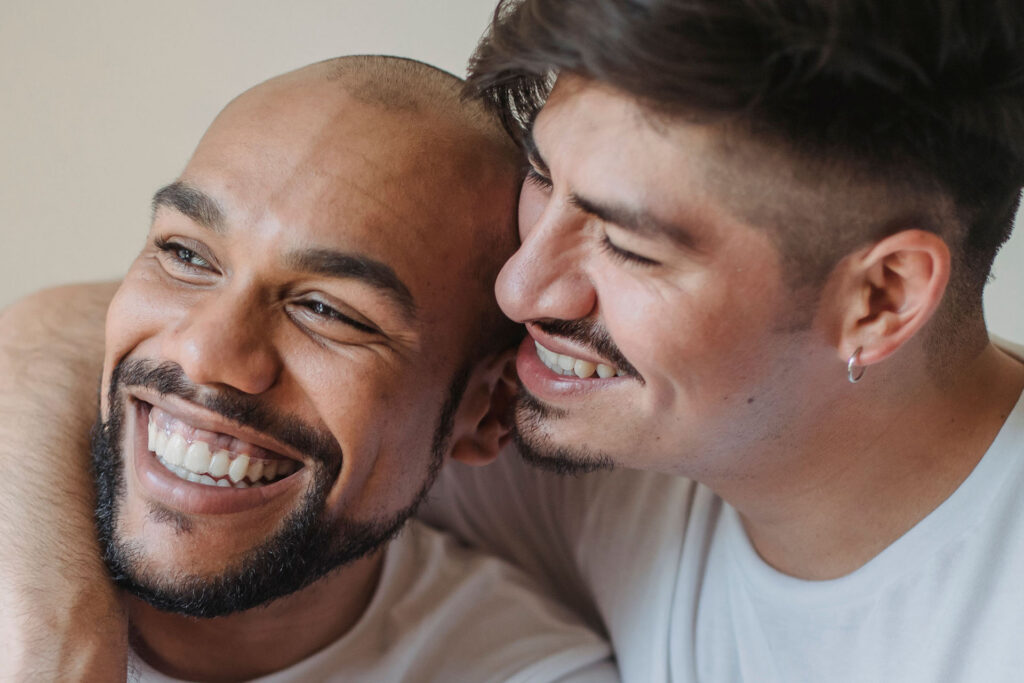
Love Across Lines: Navigating Interracial Relationships as Queer Men
David Da Silva, MSW, RSW, Ancestral Memory Therapy
Interracial relationships between queer men can be a source of deep love, growth, and expansion. They can also raise questions that partners don’t always know how to talk about: Am I being desired for who I am, or for my race? Does my partner understand what I face? Will our families accept us, and accept each other?
This post is for queer men of colour, white queer men, and mixed-race couples who want to build relationships where both people feel fully seen.
Desire, preference, and racism on the apps
Many queer men of colour have encountered profiles that say “no Asians,” “no Blacks,” or “whites only.” Others have experienced the opposite: being sought out only as an exotic fantasy. Both experiences reduce a person to a stereotype.
These moments can leave lasting marks. Some men begin to doubt their attractiveness. Others become wary of anyone outside their own community, unsure whether interest is genuine. Recognizing that these experiences are rooted in racism, not in your worth, is an important first step.
Common challenges in interracial queer relationships
- Fetishization: wondering whether a partner is drawn to you or to a racial stereotype
- Unequal awareness: one partner navigates racism daily while the other may not notice it
- Family and culture: different expectations about family, faith, gender roles, coming out, or how affection is shown
- Community belonging: feeling like you have to choose between queer spaces and your cultural or racial community
- Microaggressions inside the relationship: small comments or assumptions that hurt more because they come from someone you love
Building a relationship where both of you are seen
Talk about race early and often. Avoiding the subject can leave one partner carrying painful experiences alone. Curiosity, not defensiveness, keeps the conversation open.
Listen to understand, not to fix. When a partner shares an experience of racism, the most helpful response is often simply: “That sounds painful. I believe you.”
Do your own learning. If you are the white partner, or from a different racial background, take responsibility for learning about your partner’s history and culture rather than relying on him to teach you everything.
Honour each other’s roots. Food, language, rituals, and family stories are part of who each of you is. Make space for both.
Agree on how you’ll handle the outside world. Talk ahead of time about how you’ll respond to comments from family, friends, or strangers, so neither of you feels left on your own.
Looking deeper: an anti-oppressive and attachment lens
Anti-oppressive lens. Interracial relationships don’t exist outside of power. Sexual racism, white-centred queer spaces, and histories of colonization shape who is seen as desirable, whose comfort is prioritized, and who has to explain themselves. An anti-oppressive approach asks both partners to notice these dynamics honestly. For white partners, that means taking accountability without defensiveness. For partners of colour, it means having your experiences believed rather than debated.
Attachment lens. Racial trauma can make it harder to trust that a partner will stay attuned to you. Every time you share an experience of racism, your nervous system is asking an attachment question: “Will you be there for me?” A dismissive response can feel like a rupture, even when unintended. The good news is that relationships grow stronger through repair. When a partner acknowledges harm, takes responsibility, and stays present, it builds the kind of safety that lets both people be fully themselves.
How therapy can help
Individual or couples therapy can offer a supportive space to explore racial identity, desire, and the dynamics of your relationship. At Ancestral Memory Therapy, we recognize that each partner brings personal and ancestral histories into the relationship, including experiences of colonization, migration, and racial trauma. Making those histories visible can help couples move from misunderstanding to deeper intimacy.
Therapy can also help if past experiences of racism in dating have left you guarded, hurt, or unsure of your own worth.
Book a session
Whether you’re single, dating, or in an interracial partnership, support is available. I offer virtual therapy for queer men and couples across Ontario. Reach out to book a session with David Da Silva, MSW, RSW.