
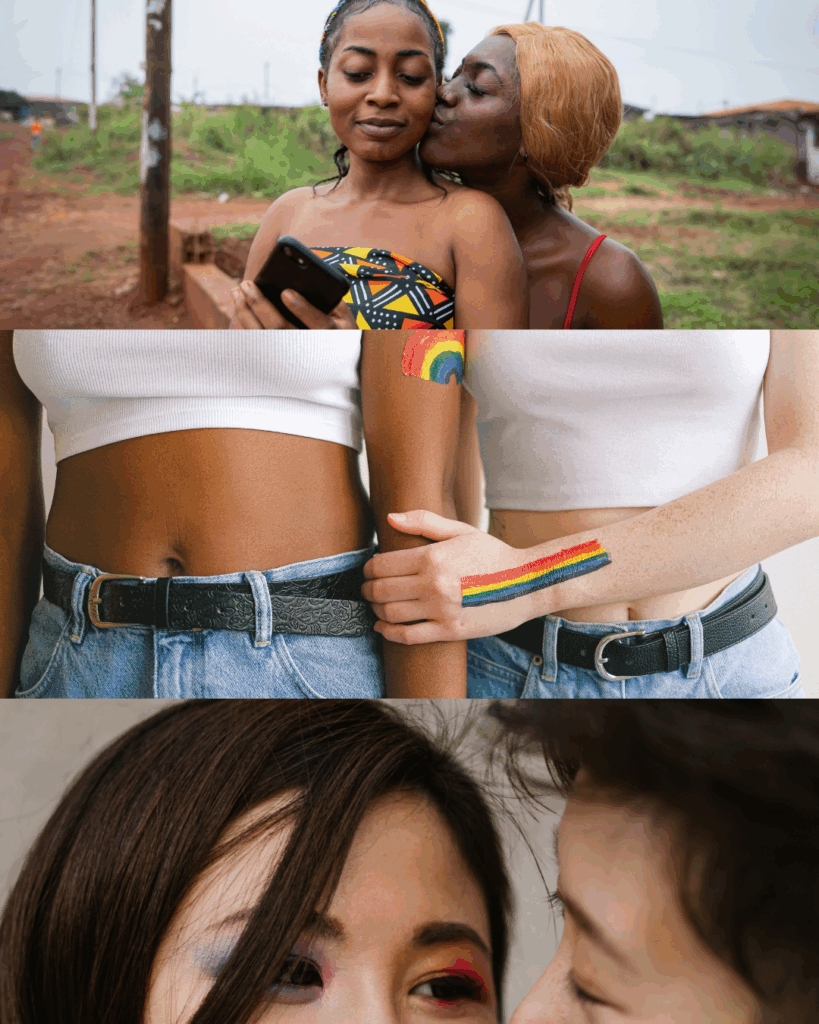
As a trauma therapist, I sit with Black and people of colour bisexually and pansexual individuals, and there is common experience shame when it comes to love. There is a consistency that presents in the therapeutic room, consistency that has to do with how much patriarchy pervades our most intimate places. Those I work with talk tenderly about the relationships they have formed with women, the softness, the emotional intimacy, the strong sense of belonging. But despite the beauty of the relationships, there tends to be an unseen fence, a feeling that something about loving another woman is more difficult to carry in the world.
For some, this boundary isn’t about their partner or even themselves—it’s about family, culture, and being seen. They fear that their relationship will be permanently diminished, that their partner will always just be “a friend” to their family. They fear the silent sadness of being invisible, or worse, the disappearance of family and community. But when they picture or have relationships with men, the potential for the future tends to be easier. With patriarchal systems, heterosexual unions are legitimate, natural, and ethnically ratified. It’s a template that everybody gets. It fits a script. But when queerness enters the picture, that script dissolves. And in the silence left behind, shame creeps in.
Patriarchy instructs us to perceive love and belonging as something that comes primarily in a mode of control, gender regulation, and family honour. It sanctions those who cross the boundaries of who we are “supposed” to love. It instructs women, particularly racialized women, that women’s love has been something that’s lower, experimental, or imperceptible. It instructs males that masculinity has something to do with dominance as opposed to softness. It instructs everybody that to deviate from the norm endangers the very fabric of community as a whole.
In the therapy room, I witness the generational echoes of this harm. Clients express guilt for desiring women, even as they long for the depth of emotional connection they find in those relationships. They grieve the potential loss of family acceptance, of cultural belonging. There’s a tension between the authenticity of their love and the safety of fitting in. And so, I hold space for both: the ache of shame and the power of truth.
Mentioning patriarchy in these discourses has been a revolutionary mentioning. Patriarchy does not just hurt women, but it dismantles love. Patriarchy has sent our ancestors to the closet, sometimes physically, sometimes to the silent sorrow of being half-living falsities. A number of queer ancestors had to hide their love tales, to safety, to shield their families and communities from rejection and belligerence. But in protecting themselves, their families, and their communities, they left behind dormant dreams, untasted tenderness, and unexpressed euphoria.
When we dare to challenge patriarchal norms that determine how love “should” be, we create a portal to mass liberation. We become clear that queerness is not a departure from tradition, it’s a continuation. It’s a testament to surviving, to creating, to rebelling. Taking queerness back means to take back the freedom to love, to be loved, and to be a member, condition-free.
Sitting with clients as they work to unwind patriarchy, I’m reminded: unwinding patriarchy isn’t a matter of individual liberation, it’s a matter of communal liberation. Each person that chooses to love openly despite fear and shame, chooses to rewrite the tale patriarchy taught us. They are honouring the queer dead that couldn’t love out loud, that whispered love in code, that passed as “friends” just to make it.
To love openly, now, is to love for them too. This work of reclamation is sacred. It is about reclaiming queerness, reclaiming love, and reclaiming belonging. When we choose authenticity, we heal backward and forward in time, restoring what was taken from our ancestors and planting something freer for those who will come after us. Our queerness is not a betrayal of our culture. It is an expansion of it. It is how we love ourselves, each other, and our histories back into wholeness. Reclaiming queerness is reclaiming love, for us, and for all those that could not love out loud.
Work with Willow